The story behind staty
Where single-person medical science fits in and helps
Hi, I'm Andreas. I develop staty as a free-forever, no-payment, no-nonsense application for everyone.
I'm a software engineer who became a hobby scientist for my own health. I track symptoms and experiments daily in a spreadsheet and analyze the data.
This approach helped me reduce migraine headaches from every 3rd day to every 13th. It also resolved a rare mental health condition. I'm working on fixing my sleep problems next, and also a chronic condition in a close family member.
This is single person medical science ("N=1"). You collect data for yourself to improve your health.
It's much more than just owning a smart watch to inaccurately track heart rate and sleep score. You decide what data to collect: symptoms, things you tried, helpful measurements (such as blood sugar or ketone levels), medication, dietary changes, and so on, all in a structured form and not just a journal.
Taking care of your own health does not mean you distrust doctors. The opposite should be the case: Humanity has vast knowledge about the general population's health, for example from large-scale studies and experiences. Those led to the development of medical guidelines. Doctors usually follow the guidelines regarding tests, medication, and patient treatment overall. The best approach combines this general knowledge with your single-person findings.
Spreadsheets, numbers, statistics
In my migraine history, one approach finally worked (documented in a blog post about my migraine improvement). Without data analysis, I would have suffered my whole life, believing and telling others that illnesses can't be improved.
Certain health conditions are reversible. Large symptom reductions are possible even if cures aren't complete.
Lastly, my data also proved that out of a thousand ideas and claims out there, most aren't working, make things worse, or are dangerous. Finding nonsense vs. reasonable solutions could save me and others a lot of time and money. Sharing the findings could help others get on top of their health, too.
This is how my data looks nowadays (simplified, not my real data) – a very structured spreadsheet that I fill in every day:
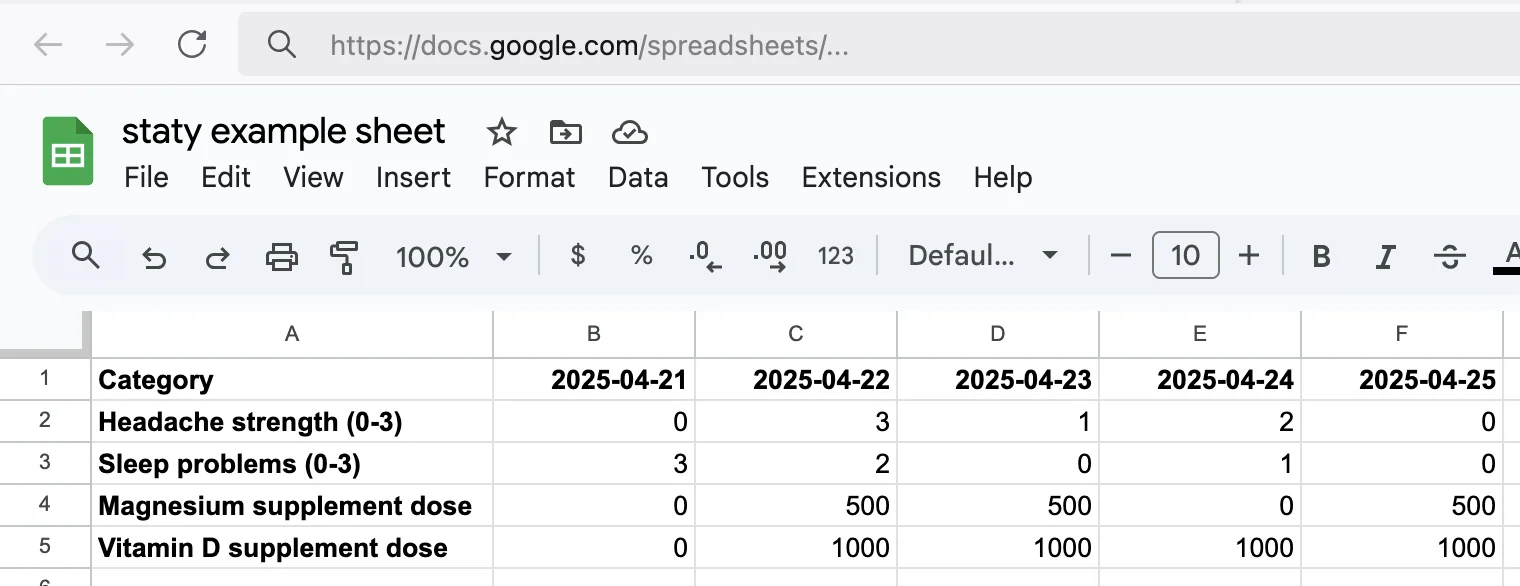
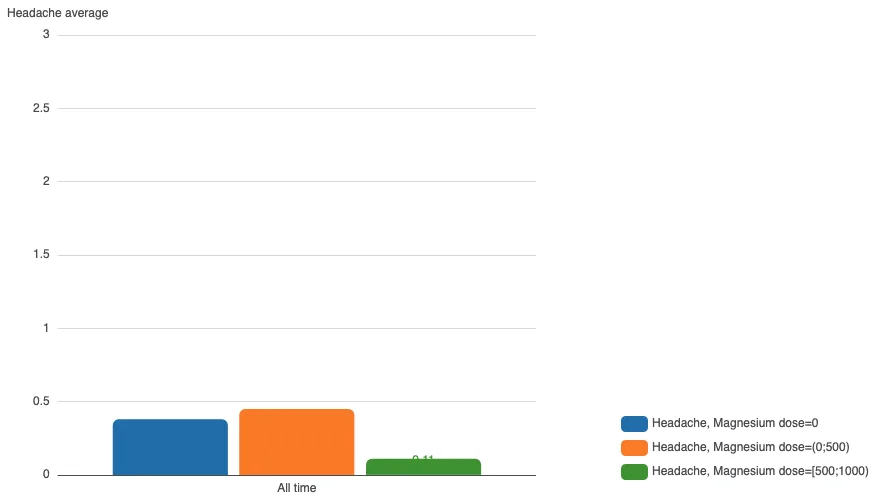
With that, correlations are easy to analyze in just a few clicks. An analysis in staty gives you a simple graph. Below, a higher dose of magnesium seems very positive to counter headache ‒ probably worthwhile to try this supplement for longer (contrived data)?!
Before staty (from "statistics") became the application it is today, I struggled with ways to make analyses easy. It takes lots of time and is complicated to do in Excel, Google Spreadsheets or data analysis software. You want to focus on what the data shows, not waste time learning complex tools.
Almost everyone knows what "average headache strength" means and why this measure would be a reasonable number to track for a headache sufferer. Simple calculations are sufficient: the average value (per month, per year, …) is usually enough for personal science. You don't need complex statistical constructs: no p-values, 95% confidence intervals, or standard deviations. It's just your individual data and simple average numbers that you need to interpret, visually shown in graphs that staty generates in a few clicks. With experience, and our "Learn health science for yourself" guide, you'll find meaningful results.
But you will also find things that just don't work for you. In the example above, maybe magnesium shows no difference after a few months. That's valuable information, saving you money and avoiding wasted time with urban myths.
Once you see the value, entering data in a spreadsheet every day probably doesn't seem so intimidating anymore. And maybe you'll even share some positive results with others?
Solving medical problems can come in many forms: following medical expert advice, medication, lifestyle changes, training, supplements, dietary changes and exclusions, and so on. There's no one-size-fits-all – get started improving your individual health today!
In summary…
staty helps you take control of your health. It turns daily observations into clear answers.
Fill in a simple spreadsheet each day. Analyze the data over time. It's health optimization made practical: track symptoms, test changes, spot correlations, and make decisions based on your own data. See whether your health experiments work. Stop things that don't work. No complex statistics. No expensive tools. No medical degree required. It can't replace medical professionals, though!
Ultimately, you may improve or get rid of symptoms and illnesses this way. It's definitely my goal, and that's why staty is free forever with no money, business or even donations behind it, since I have a regular job to pay me, and don't need to hide some advertisement monetization, product placement or paid sponsorship behind this app.