Read your data with standard formats
Once you followed the guide to create a health data spreadsheet, you want to read data from it. The easiest way is a standard format: we provide and explain the format how you should note down data, and you don't need to program anything. This makes sense if you start from an empty spreadsheet and are fine following our recommended formats. That other guide already used a standard format for the "Headache score" example.
Standard formats work like this:
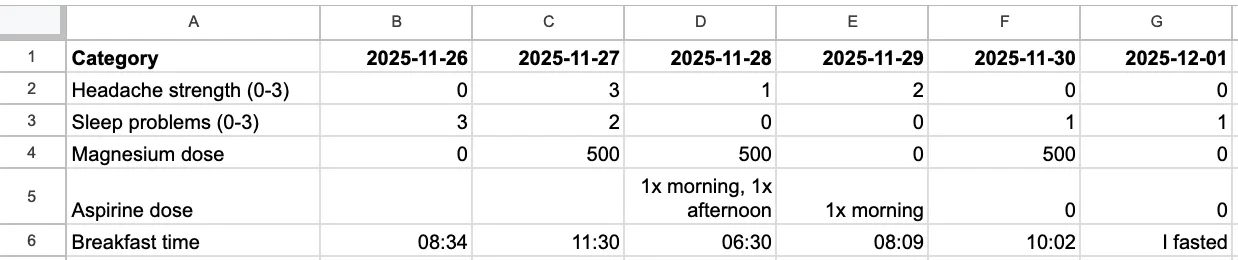
An outcome needs two steps for this. First add Read value from spreadsheet row and choose which row to read. Then add Read with standard format (recommended), which parses the value that the first step read. The outcome must look as follows (of course, name it whatever you want):
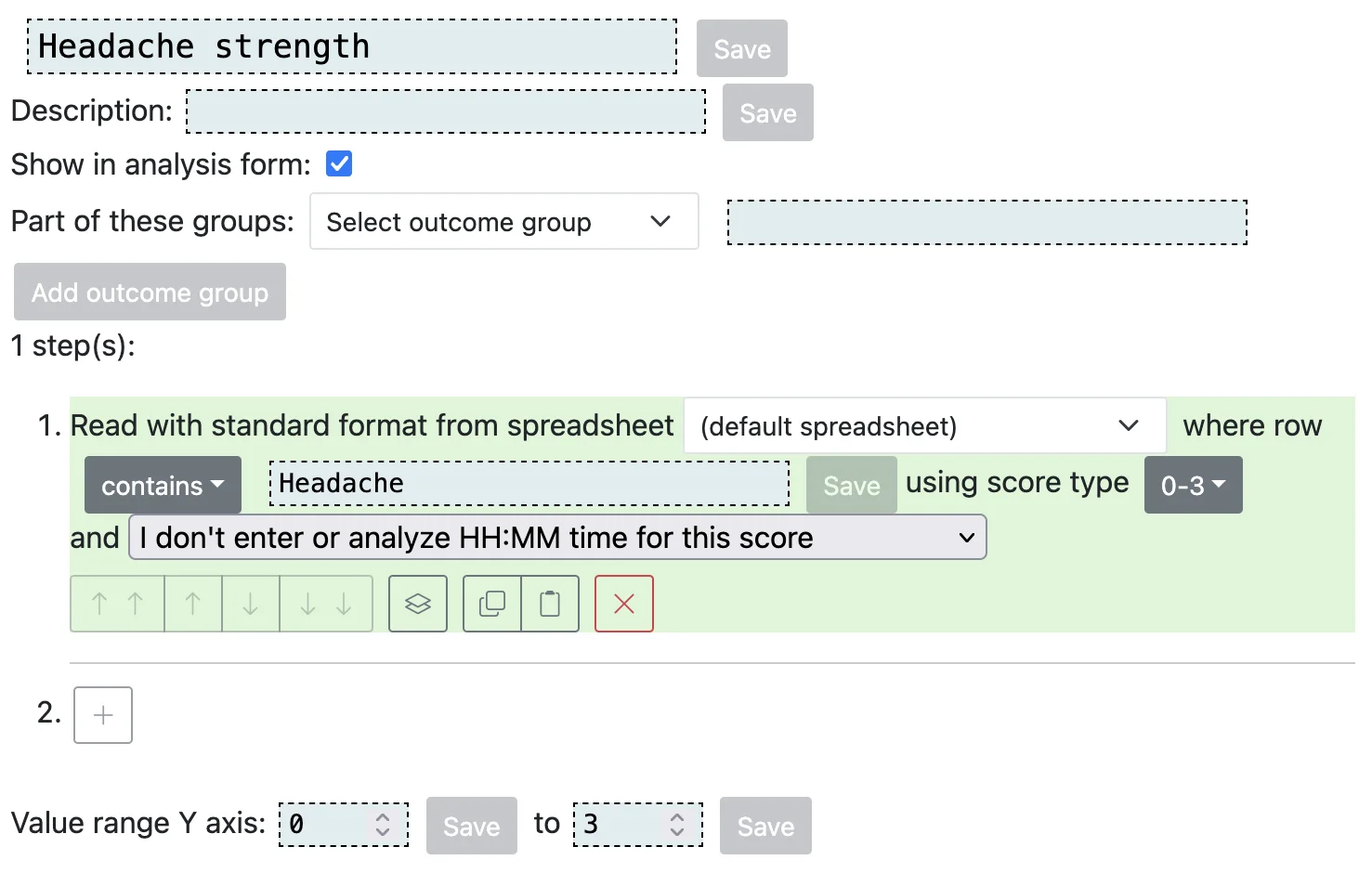
There are three standard formats today. Each one fits a different kind of thing you write down:
Score (e.g. strength of a symptom on a number scale)
Examples:
3(without time)14:30, 3(with time, e.g. when headache started)
Products (e.g. intake or use of medication or supplements)
Examples:
SuperHealth Vitamin C retard 3x(without time, count of pills)SuperHealth Vitamin C retard 1500 mg(without time, amount/mass)14:30, SuperHealth Vitamin C retard 1x(with time, e.g. when you took it)
- a time of day (e.g. when you did something, such as attempting to sleep)
For more details, when to choose each format, and which outcomes don't have a standard format yet, keep reading.
Score: rate a symptom on a number scale
Use this when you write down a single number on a fixed scale. You choose the scale once from these predefined options: 0-1, 0-3, 0-5, 0-10, 1-3, 1-5 or 1-10. Here are some recommendations which one to choose.
The minimum number is either 0 or 1. For symptoms or observations that can be "nothing", "no pain", "no sleep issues", "no binge eating", use a score starting with minimum 0, such as for headache, dizziness, nasal congestion, anxiety, anger or sleep problems. For something that is "always there" and cannot be nothing, use a score starting with minimum 1, such as for mood, how your day was, well-being, or as a special case, a doctor-provided pain scale (often 1-10 in hospitals).
At best, you define exactly what each score number means. If you cannot tell a 7 from an 8, probably better go for score range 1-5 where you can clearly distinguish between all numbers? Example definitions below.
Decide if you prefer "higher is better" (sleep quality) or "lower is better" (sleep problems). It's all your choice of interpreting the score numbers.
Scores are good for:
- Headache strength on
0-3(0 = no headache, 1 = light, 2 = quite some pain, 3 = day ruined such as a full migraine). If you're a patient with a more extreme pain maximum, such as cluster headache, maybe even0-5could work. - Sleep problems, also a good fit for
0-3(0 = great sleep, no problems getting out of bed or falling asleep, 1 = mild problems such as waking up too early or feeling a little groggy in the morning, 2 = moderately severe issues like trouble falling asleep, waking up in the middle of the night, or not feeling rested, 3 = the worst imaginable, feeling of not having slept at all) - Mood, anxiety, irritability, brain fog, energy and other mental or behavioral symptoms
- Pain, which doctors and studies often ask for on
0-10or1-10. We however recommend choosing a range where you can distinguish each number, as explained in the above examples. - Yes/no entries like "Did I exercise today?" on
0-1(you can also write down the time of exercise such as14:30, 1)
2. Optionally, you can put a time of day in front so you also know when it happened, for example 08:37, 2. If you want to note down something after midnight, but still count it towards today, for instance because you didn't go to bed yet, you can use an hour of 24 or greater: 25:37, 2 (that's 01:37 AM on the next day). A comment in parentheses is also allowed and gets ignored, for example 06:15, 3 (woke up with migraine and nausea).Products: medication, supplements and similar
Use this for anything you take in a dose: medication, supplements, vitamins, electrolytes. You configure each product name and its doses once, then write down what you took. staty adds up the amounts as plain numbers. The unit, such as mg (milligrams) or IU (international units), is yours to keep consistent and isn't known or used in the analysis. Consider adding it to your outcome name or description, e.g. "Vitamin C (in mg)".
Good for:
- Medication, for example
Aspirin 500 mg - Supplements and vitamins, for example magnesium or vitamin C
- Combined products with several active ingredients. One intake can add to more than one outcome, for example a capsule that contributes to both a "Vitamin C" and a "Zinc" outcome.
The value you write can be as simple or as detailed as you need:
0means you took nothing that day.(empty value) means you forgot to write down intake on a day. Nothing will be counted.supermartVitC 500 mgis a single intake of a configured product21:30, supermartVitC 500 mgadds the time you took it. Writing down the time is optional, but it can sometimes be helpful, for example to answer questions like "Does magnesium help me for my sleep if taken in the evening?".7:30, supermartVitC 500 mg, 20:00, retardC 2xrecords several intakes on one day, each with its own time. Here, the "retardC" vitamin C product is configured to say how much1x(one pill, one serving, etc.) means, and specifying a multiplier like2xscales the configured dose automatically. For example, if you configure1xto mean 500,2xwill count 1000 (e.g. milligrams; unit isn't important).supermartVitC 500 mg, retardC 2x: same without time (specifying the time is optional).
07:50, productWhereIRememberTheTime 1x, no time, retardC 1x (if you prefer another marker, you can use any of these: no time, notime, unknown time, ??:??, ? or time?).25:37 (that's 01:37 AM on the next day). A comment in parentheses is also allowed and gets ignored, for example retardC 1x (felt sick afterwards).Time: a single time of day
Use this when the value is a clock time. You write it in 24-hour HH:MM format, for example 23:10 or 07:30. The short form 7:30 works too.
Good for:
- Time of first sleep attempt
- Time you woke up
- Breakfast or first-meal time
- When a symptom first started
25:37 (that's 01:37 AM on the next day). A comment in parentheses is also allowed and gets ignored, for example 06:15 (went to bed with migraine).Why standard formats?
When you start writing down health data, you usually know almost nothing about how to do it well. For example, as author of staty, it took me several years to even start tracking food intake, which is complex and takes a lot of time. But once that started, it solved major health problems within a few months by uncovering severe food intolerances. Now imagine someone else who reacts badly to certain foods but doesn't know it yet. We want that person to have the easiest possible start with a spreadsheet and its analysis.
That's what standard formats are for. People can share what they learn about a format. Videos and guides can explain how to enter and use exactly that format. And because everyone's data looks the same, users of staty don't get confused when talking in forums or chats. They can even share and prove health observations by exchanging the data itself.
Think of other standards that saved the world a lot of time and effort: audio tapes, CD-ROM, VHS, DVD, USB cables. There's no reason to invent the same thing twice – unless you can do it a lot better. If a sensible standard already exists, built on years of experience, use, research and development, most people should just use it, not invent their own.
When standard formats aren't enough
Standard formats cover the most common cases on purpose. We want to make health statistics simple.
If you're an advanced user, or you already kept a health spreadsheet before staty with your own notation, your values may not match any of the standard formats above. In that case, you can read the raw cell values instead and program your own steps to convert or change them as needed to get the value or number that you want to analyze as an outcome. It's more work, but there's no need to rewrite years of existing data just to fit a standard format. Your choice. If it feels too complicated to develop custom steps just to analyze your spreadsheet data, please send us feedback!
Formats that we want to standardize in the future
A few things are deliberately missing, because we want real feedback from users before settling on a format that's hard to change later:
- Sports: This can vary a lot regarding which detail you may want to write down – type of workout, training duration, intensity, heart rate, max heart rate, track length, blood pressure during training, fatigue level during or after the session, … Possibilities are endless and therefore it's unclear if this can even be standardized.
- Diet (food and drinks): In our view and experience, what we ingest into our body has the potential to both detect symptom triggers, and heal health conditions. Writing down food, and detecting problems from taking or excluding certain food items, is complex if done right. We first want to collect more experience with how people write down what they eat and drink before proposing a standard format.
If we add a new standard format later, it will still be possible that you switch your spreadsheet to use it. And even your own ways of noting stuff down can change. All you probably need is a step that does if date < 2025-12-30 then ... else ... (where 2025-12-30 is the switchover date between two formats). Or instead, since you have full control over your spreadsheet, you can fix up all the older entries to match your (or our) new, better format. Or sometimes, if the meaning of a spreadsheet row changes, such as going from score range 0-3 to 0-5, you just have to start from scratch and not try to interpret the old data with some new meaning.
If you make use of the above formats or suggestions, or you don't because they don't fit, let us know suggestions and problems in the feedback form. Your examples directly shape how we improve staty and its supported formats in the future.